Today’s air display in flying order — what each aircraft is actually doing, what you’re hearing, and which of them were built or are based at this airport. Written to be read from a parking spot.
Gates10:00
Show start12:45
Weather21°C · showers · NW 30 g50
Payment on siteCredit only — no cash
CommentaryFM — bring a portable radio
Three things here are local
You are parked at an airport that builds aeroplanes and restores jets, and three acts today come from within a forty-minute radius: the Diamond DA40/DA62 are manufactured on the far side of this runway, the Harvards belong to the Canadian Harvard Aircraft Association in Tillsonburg, and the CT-133 Red Knight is the Jet Aircraft Museum’s, based here at YXU.
On today’s weather
Low cloud forces the jet demos into a flat show — the low-ceiling profile. No loops, no vertical climbs, everything horizontal. It is not a lesser show: passes come closer, faster and louder, with far more topside views. Photographers prefer it.
Gusts to 50 km/h threaten two acts specifically: the SkyHawks jump and the helicopter hoist demo. Thunder within range stops all flying and you will be asked into your vehicle — it nearly always resumes, so don’t leave on the first rumble.
Canadian Armed Forces Parachute Team · est. 1971 · CFB Trenton
Wind-sensitive
Canadian Forces SkyHawks · Wikimedia Commons
Almost every airshow opens with a jump, because it is the one act that can put a flag over a crowd at walking pace. The SkyHawks are the Canadian Armed Forces’ only parachute demonstration team, and they have been doing this for fifty-five years.
Exit altitude
~12,500 ft
Freefall
~190 km/h
Canopy
Ram-air
Team
~16 members
Platform
CC-130 / Twin Otter / Skyvan
Watch for
Find the aircraft first. A slow, high, straight-and-level pass into wind. You will see specks before you see canopies.
The stack. Once open they descend in a stepped column, each jumper holding vertical separation. That is formation flying under fabric.
The flag jumper lands last, into wind, on the centre point, with a deliberate flare a metre off the deck.
One fact
SkyHawks are not full-time jumpers. They are serving members from any trade — cooks, technicians, infantry — who volunteer, get selected, and train up for a single season before returning to their units. The team is largely rebuilt from scratch every year.
Today
This is the act most likely to be scrubbed. Northwest gusts to 50 km/h sit well outside demonstration limits; the usual threshold is around 30 km/h at the drop zone. If the show opened with the CF-18 instead, this is why.
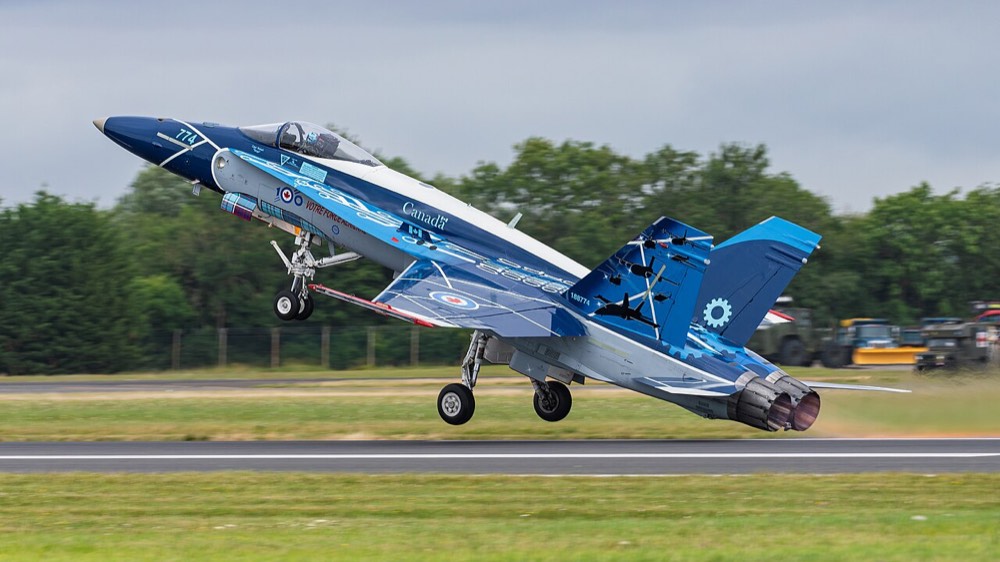
Canada’s fighter for forty-four years and counting. Canada bought 138 in the 1980s and has flown them over Iraq, the Balkans, Libya and Syria, and through every NORAD intercept since — long past the retirement date anyone originally planned.
Purchased
138 (1982–88)
Engines
2 × GE F404
Top speed
~Mach 1.8
Designation
CF-188
Replacement
F-35A, 88 ordered
Paint
New demo scheme each season
Look under the nose
Canadian Hornets carry a fake cockpit canopy painted on the underside of the forward fuselage. In a close-in turning fight an opponent gets half a second of confusion about which way up the aircraft is — and in a dogfight half a second is a great deal. It is an RCAF signature and one of the last genuinely clever low-tech ideas still flying on a modern fighter. Look for it on any topside or knife-edge pass.
Context worth having
The replacement saga ran nearly two decades: an F-35 commitment, a cancellation, an attempt to buy Super Hornets, a trade fight with Boeing, a stopgap purchase of second-hand Australian Hornets, and finally an F-35A order. First Canadian F-35s are arriving now. Every CF-18 demo season from here is one of the last.
Today
Under a low ceiling the Tac Demo drops its vertical set-pieces and flies a tight horizontal pattern — more topside, more knife-edge, more passes closer to you. For spotting that false canopy it is the better show.
03
Harvard Mk II & Mk 4
Canadian Harvard Aircraft Association · AJ583 C-FHWX & 20242 C-FWPK · Tillsonburg, ON
Local · 40 min away
North American Harvard / T-6 Texan · Wikimedia Commons
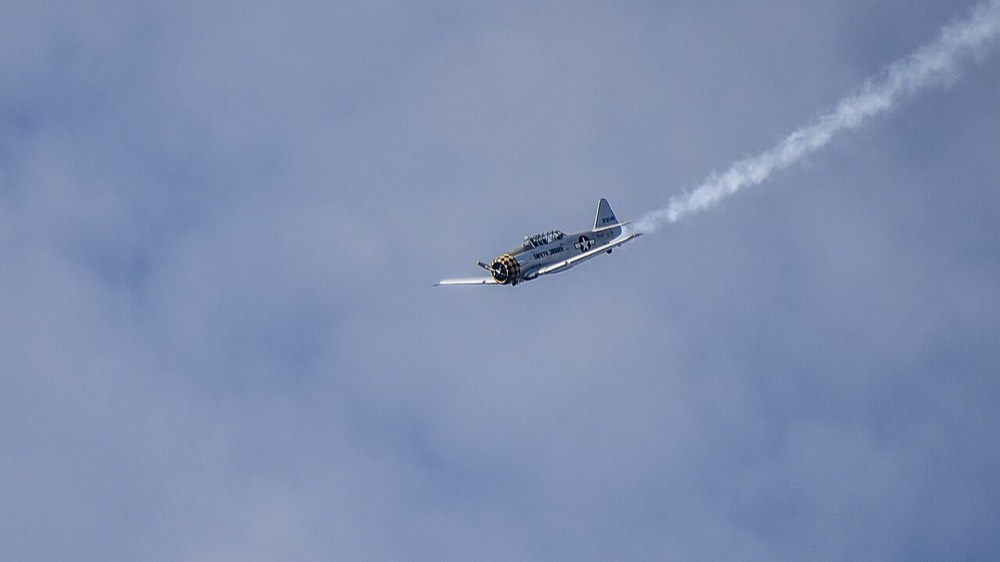
If one aeroplane belongs in the sky over southwestern Ontario, it is this one. Under the British Commonwealth Air Training Plan, Canada trained more than 130,000 Allied aircrew — and the Harvard was the aircraft that took a student from “can fly” to “can fight.” Half the airfields in this part of the province exist because of it.
Engine
P&W R-1340 Wasp, 600 hp
Top speed
~330 km/h
Crew
2, tandem
Built
15,000+ all marks
Mk 4
Built in Canada, post-war
The local connection
These two airframes belong to the Canadian Harvard Aircraft Association, based at Tillsonburg Regional Airport — about forty minutes east of where you are parked. CHAA is a volunteer organisation that has kept a flying fleet of ex-RCAF Harvards airworthy for decades. The Mk 4 was built in Canada, and the RCAF flew Harvards as its primary trainer until 1965.
The sound — this is the point
The Harvard is famous for a hard, buzzing rasp unlike any other radial, and it comes from the propeller rather than the engine. The blades are long and geared to turn fast, and at high RPM the tips go transonic. You are listening to the tips of a 1930s propeller punching through the sound barrier. Towns near wartime training fields called it the Yellow Peril partly for the noise.
Watch for
Listen through a wingover: as the pilot pulls, the prop unloads and the rasp softens, then bites back on the way down. Two aircraft means formation work — watch how tight they hold, on aeroplanes with no formation aids whatsoever.
04
MV-22 Osprey
United States Marine Corps · Bell Boeing tiltrotor
Nothing else like it
Bell Boeing V-22 Osprey · Wikimedia Commons
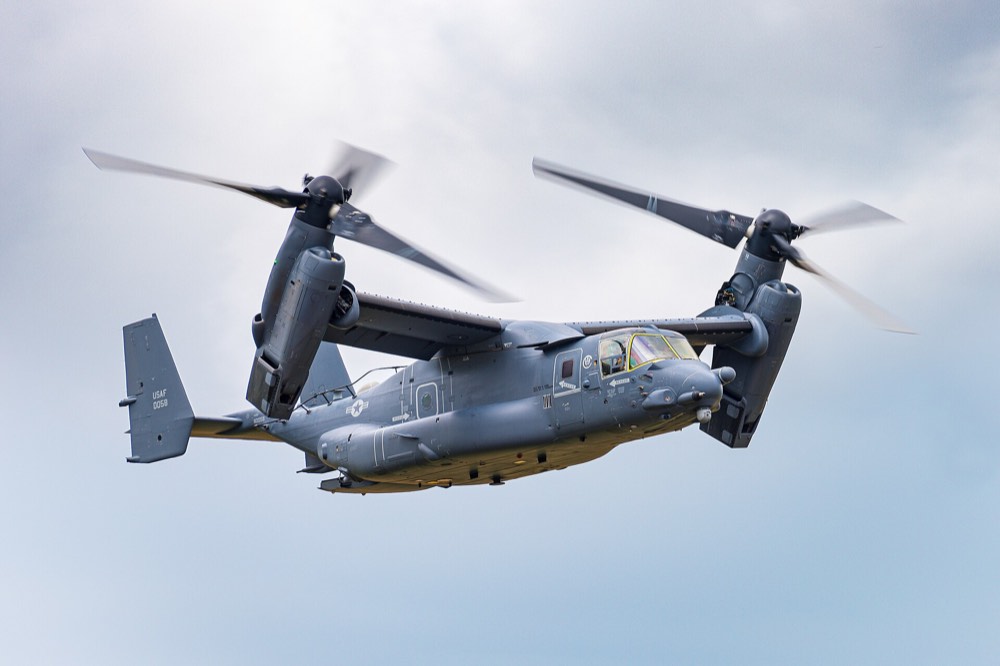
There is nothing else flying that does this. The Osprey takes off as a helicopter, rotates its engine nacelles forward over about twelve seconds, and becomes a turboprop aeroplane — roughly twice the speed and five times the range of the helicopter it replaced, while still able to land in a clearing.
Cruise
~520 km/h
Transition
~12 seconds
Rotor diameter
11.6 m each
Troops
24 seated
First flight
1989 · service 2007
Wing stow
Rotates 90° in ~90 s
Watch the nacelles, not the aircraft
The transition is the single most distinctive manoeuvre you will see today. As the nacelles rotate from vertical to horizontal the machine changes what it fundamentally is, mid-air, and the sound goes with it — from a heavy chopping beat to a smooth turboprop drone. On a straight pass, look for a partial tilt in the turn.
One fact
Its rotors are so large that it cannot make a conventional runway landing with the nacelles level — the blades would strike the ground. A twenty-five-year, deeply troubled and often fatal development programme produced an aircraft that genuinely does something nothing else can.
05
Diamond DA40, DA50, DA62
Diamond Aircraft Industries · built at this airport
Built hereThe one to actually watch
Diamond DA62 · Wikimedia Commons
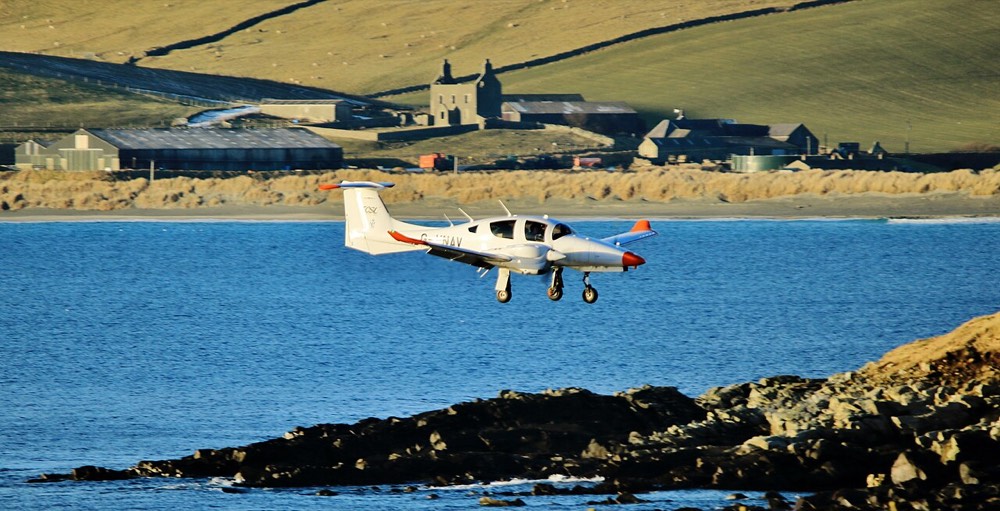
Do not treat this as the filler slot. These aeroplanes were manufactured on the far side of the runway you are sitting beside. Diamond Aircraft’s Canadian plant is on Crumlin Sideroad at London International Airport, and it is where the DA20, DA40, DA42 and DA62 are built.
Built at
London International Airport
DA40
4-seat single, composite
DA62
7-seat twin, diesel
Engines
Jet-A burning diesels
Airframe
Carbon-fibre composite
Owner
Wanfeng Aviation, since 2017
The building has a second life
The London plant occupies a Second World War aircraft factory. It was Central Aircraft Company, and it worked on de Havilland types — Mosquitoes among them — when Canada was building combat aircraft at industrial scale. Eighty years later the same floor turns out carbon-fibre light twins that burn jet fuel. Very few airshow acts fly directly over their own birthplace.
Watch for
The composite airframe. No rivets, no panel lines, continuous compound curves. Next to the Harvard it looks like a different species, because it is — carbon fibre instead of aluminium over a frame.
The DA62’s engines. Two diesels burning Jet-A, not avgas. Roughly forty percent less fuel per hour than a comparable piston twin, and it runs on the fuel that is available everywhere in the world.
The wings. Very long, very slender, very high aspect ratio — Diamond’s design DNA comes from motor gliders, and it shows in how the aircraft float.
One fact
Diamond builds airframes so efficient that its aircraft are the default trainer for a large share of the world’s flight schools. If a pilot has learned to fly in the last fifteen years, there is a real chance they learned in something made a few hundred metres from your parking spot.
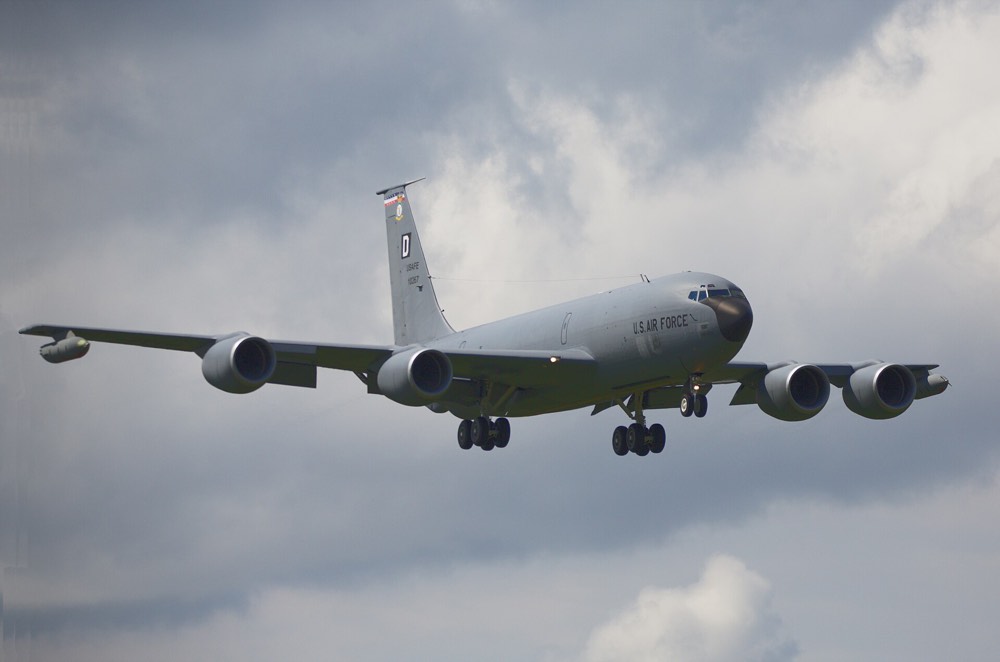
KC-135 Stratotanker and KC-46 Pegasus · Wikimedia Commons
Two tankers, seventy years apart, flying together. This is the most instructive pairing on today’s card: an aircraft from 1956 that works, and its replacement, which is still finishing its homework.
KC-135 in service
1957 — 803 built
KC-135 offload
~90,000 kg
KC-46 first delivery
2019
KC-46 offload
~94,000 kg
Altus role
Trains every USAF tanker crew
Watch for what is missing
On the KC-135, the boom operator lies face-down in the tail, looking through a window, flying a rigid telescoping tube into a receptacle using small control surfaces near its tip. It is the last job in the US Air Force performed prone.
On the KC-46, there is no window. The operator sits up front behind the cockpit and flies the boom on screens fed by stereoscopic cameras. That Remote Vision System has been the programme’s defining defect: in certain sun angles the depth perception degrades enough that operators have scraped receiving aircraft. It has been a category-one deficiency for years.
The lesson
Replacing a direct human view with cameras sounded like straightforward modernisation. It turned out that binocular depth perception, in glare, at closing speed, against a stealth coating, is a hard problem. The old tanker’s window remains undefeated — and the KC-135 is now projected to fly into the 2040s.
Not a 707
People say the KC-135 is a Boeing 707. They are cousins, not twins: both descend from the 1954 Dash 80 prototype, but Boeing gave the tanker a narrower fuselage and different structure. It matters to anyone who has ever had to find a part for one.
07
MiG-17
Mikoyan-Gurevich · first flight 1950 · privately operated
Rare
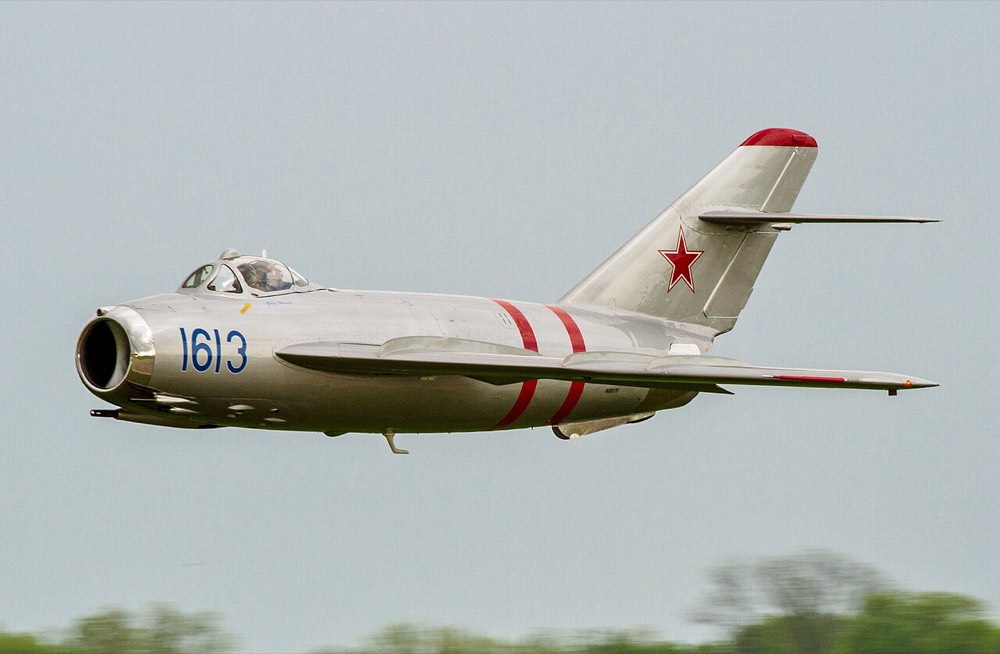
Mikoyan-Gurevich MiG-17 · Wikimedia Commons
A privately owned Soviet fighter is an unusual thing to see anywhere, and this one carries more history per tonne than anything else on the field.
Engine
Klimov VK-1F, afterburning
Top speed
~1,145 km/h — subsonic
Wing sweep
45°
Guns
1 × 37 mm + 2 × 23 mm
Built
~10,000+ with licence copies
TOPGUN exists because of this aeroplane
Over Vietnam, subsonic MiG-17s repeatedly shot down supersonic, missile-armed F-4 Phantoms. The MiG could not run, but inside a turning fight it was smaller, tighter and gun-armed, while American crews had been trained to believe dogfighting was obsolete. The exchange ratio got bad enough that in 1969 the US Navy stood up its Fighter Weapons School — TOPGUN — specifically to relearn air combat manoeuvring. This is the aircraft that forced it.
The sound
Completely unlike everything else today. The VK-1 is a 1940s-lineage centrifugal-flow turbojet: no bypass, no modern noise attenuation. Raw, hollow, tearing, with a hard crack when the afterburner lights. Once you have heard a MiG-17 you can name one blind.
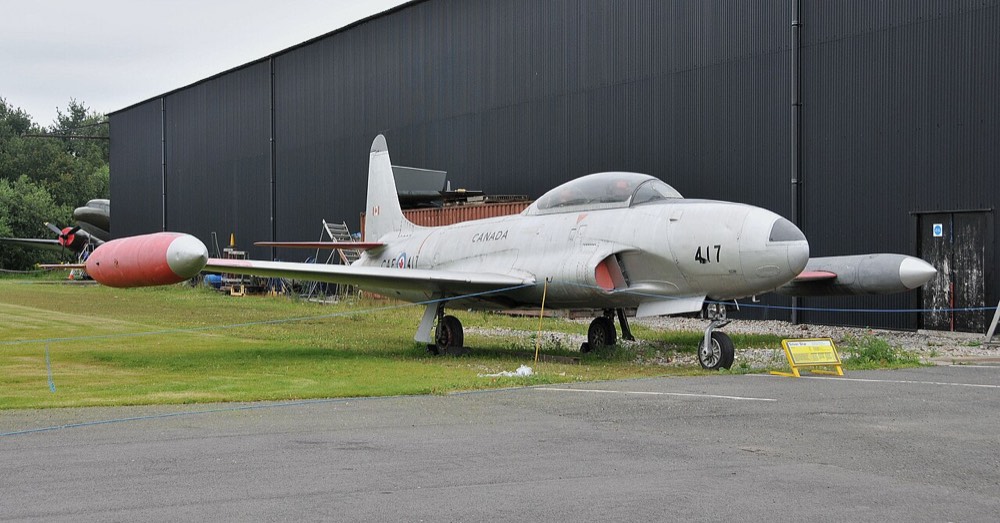
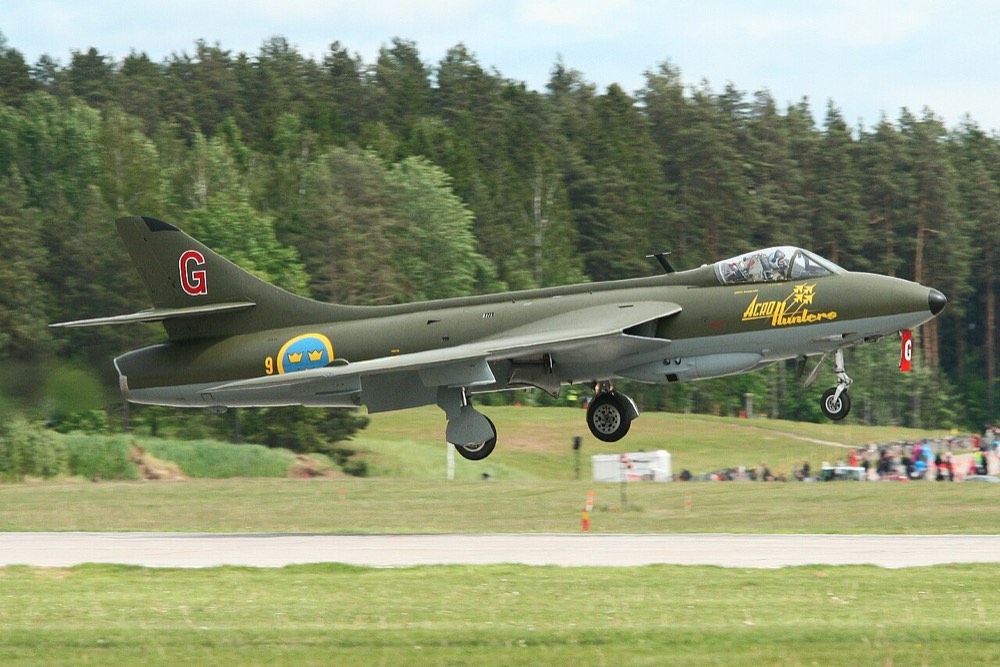
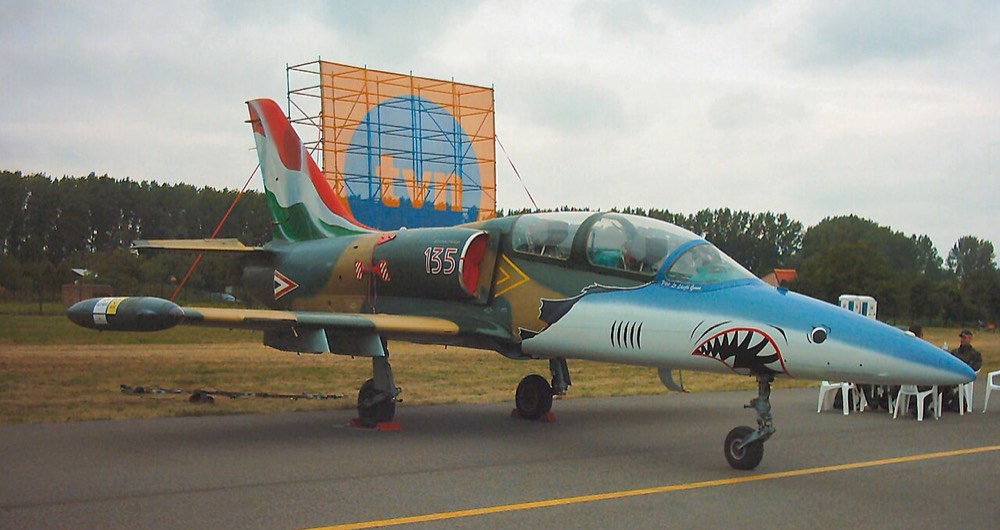
Four aircraft in one slot, and the most quietly local segment of the day. London’s own Jet Aircraft Museum is based at this airport, owns four ex-Canadian Forces CT-133s, and has a Hawker Hunter in its collection.
CT-133
Canadair-built T-33, Nene engine
Red Knight
RCAF solo display, 1958–69
Hunter
Hawker, 1951 · 1,972 built
L-39
Aero Vodochody · 2,800+ built
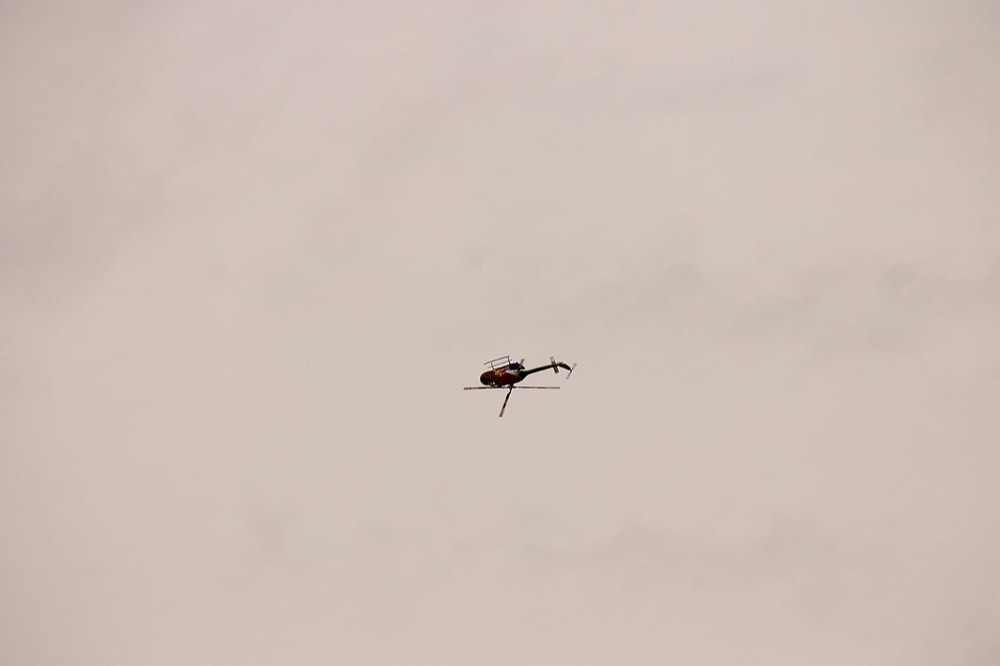
Bo 105
First hingeless-rotor light twin
The Red Knight
Before the Snowbirds, the RCAF’s solo aerobatic display was the Red Knight — a single bright red T-33 that flew loops, rolls, Cuban eights and inverted passes across North America from 1958 to 1969. The Jet Aircraft Museum restored one of its CT-133s to airworthiness in that scheme and flew it publicly for the first time here at London in 2018.
The Canadian connection runs deeper: Canadair built the T-33 under licence as the CT-133 Silver Star, but fitted a Rolls-Royce Nene rather than the American engine. It is not quite the same aeroplane as a US T-33, and it does not sound like one.
The Bo 105 is the one to watch
Most helicopters cannot do aerobatics. The Bo 105 can, because it was the first light twin with a hingeless, rigid main rotor — the blades flex rather than pivoting on hinges, so the rotor keeps producing usable control even at low or negative g. It can loop and roll. If you see a helicopter go inverted today, that is why, and it is genuinely rare.
The Hunter
Widely held to be the most beautiful jet ever built, and fast enough to prove it: in September 1953 Neville Duke took a Hunter to a world air speed record of 727.6 mph. Nearly two thousand were built and some served into the 2000s.
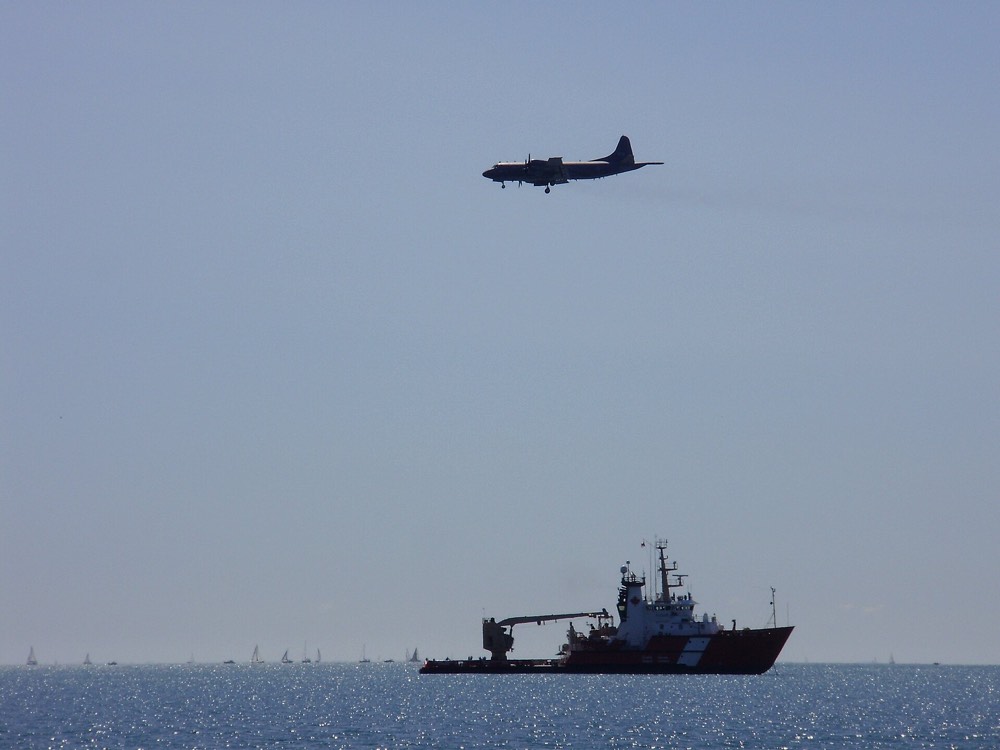
A Canadian hybrid: the airframe of a Lockheed P-3 Orion married to mission electronics originally developed for the carrier-based S-3 Viking. It hunts submarines, patrols the Arctic, watches fishing fleets, runs search and rescue, and since its sensor upgrades does overland surveillance too.
Engines
4 × Allison T56 turboprop
Endurance
10+ hours
Crew
up to ~15
Delivered
1980–81, 18 aircraft
Fleet now
~14, heavily modernised
Replacement
P-8A Poseidon
Watch for the sting in the tail
That long thin boom projecting aft from the tail is a magnetic anomaly detector. It is mounted that far out to get the sensor away from the aircraft’s own metal and electrical noise. When an Aurora is genuinely hunting a submarine it flies low and slow with that boom trailing behind it.
Why it is still here
Canada rebuilt these aircraft rather than replace them — new wings, new mission systems, new sensors — stretching a 1980 airframe past 2030. The P-8 order finally ends that. This may be one of your last chances to see an Aurora at an airshow.
10
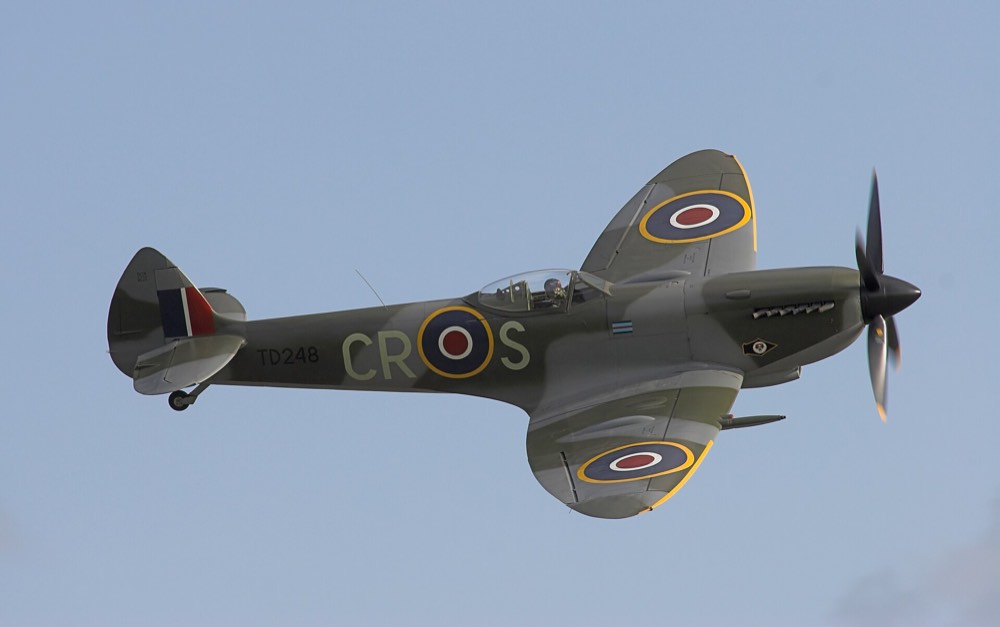
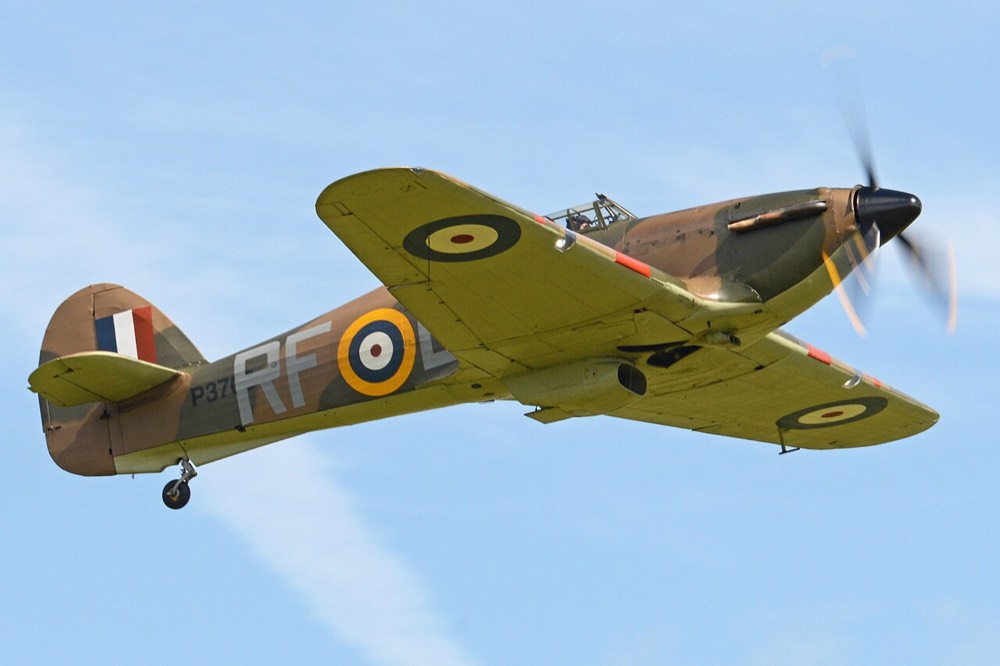
Spitfire & Hurricane
Supermarine Spitfire · Hawker Hurricane
Don't missCanadian story
Supermarine Spitfire and Hawker Hurricane · Wikimedia Commons
The famous one and the one that actually did the work. Flying them together is the point: the Spitfire got the reputation, the Hurricane got the score.
Spitfire first flight
5 March 1936
Spitfires built
20,351 across 24 marks
Hurricane first flight
6 November 1935
Hurricanes built
14,000+
Both powered by
Rolls-Royce Merlin V-12
The Hurricane got the score
In the Battle of Britain, Hurricanes shot down more enemy aircraft than every other British defence combined — Spitfires, anti-aircraft guns and everything else together. There were simply more of them, they were steadier gun platforms, and they were far easier to repair. The Spitfire is the aeroplane people remember; the Hurricane is the one that held the line.
Elsie MacGill built Hurricanes in Ontario
Canadian Car & Foundry in Fort William — now Thunder Bay — built roughly 1,400 Hurricanes. Its chief aeronautical engineer was Elsie MacGill, the first woman in the world to earn an aeronautical engineering degree and the first to design and put a production aircraft into service. She ran the Hurricane line, and the wartime press called her the Queen of the Hurricanes. The same company later built Harvard Mk 4s — the aircraft in slot 03.
Telling them apart
Spitfire: elliptical wing, curves everywhere, all-metal stressed skin. Hurricane: thicker, squarer wing, a taller and more upright stance, and a rear fuselage that is fabric over a steel tube frame — which is exactly why groundcrew could patch one overnight and put it back in the air. Both run a Merlin, so they sound like brothers. The airframes are how you call it.
Photo note
Slow to 1/200 s or slower. A frozen propeller disc reads as a broken aeroplane and will spoil an otherwise good frame.
11
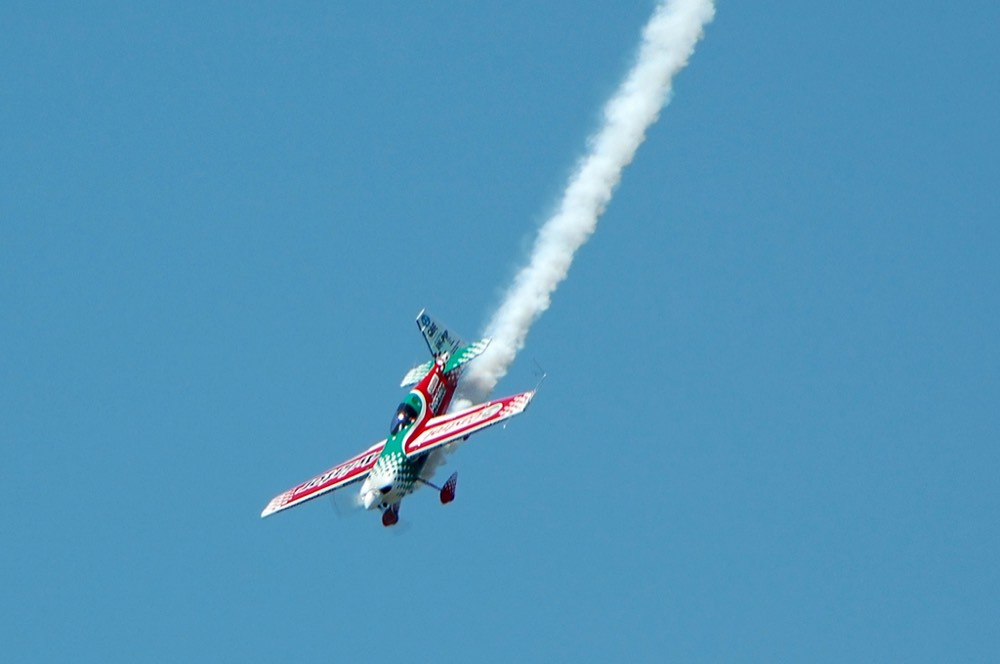
Mike Tryggvason — Edge 540 V3
Zivko Edge 540 · Canadian unlimited aerobatics
Highest g of the day
Zivko Edge 540 · Wikimedia Commons
The smallest, lightest aircraft on the card, and the one that will pull the highest g by a wide margin. Everything else here is a machine built for a job with a display routine bolted on. The Edge exists only to be thrown around.
Roll rate
~420° per second
G envelope
roughly +/-10 g
Engine
Lycoming, ~330 hp
Empty weight
~500 kg
Power-to-weight
near 1:1
Pilot
Mike Tryggvason, Canada
Watch for
The roll rate. Over 400 degrees a second means more than a full rotation per second. Fighter jets do not come close.
Tumbling manoeuvres. Look for the Lomcevák and the knife-edge spin — the aircraft departs controlled flight deliberately, tumbles end over end, and is recovered. On any other aircraft here that would be an emergency.
Hanging on the prop. With near 1:1 power-to-weight it can hover on thrust alone, nose vertical, going nowhere.
Why it looks so violent
A symmetrical aerofoil and enormous control surfaces mean it flies identically upright and inverted, and responds instantly. Airshow crowds routinely find the small aerobatic slot more visceral than the fighters, because everything happens close, low, and in front of you rather than a kilometre away.
12
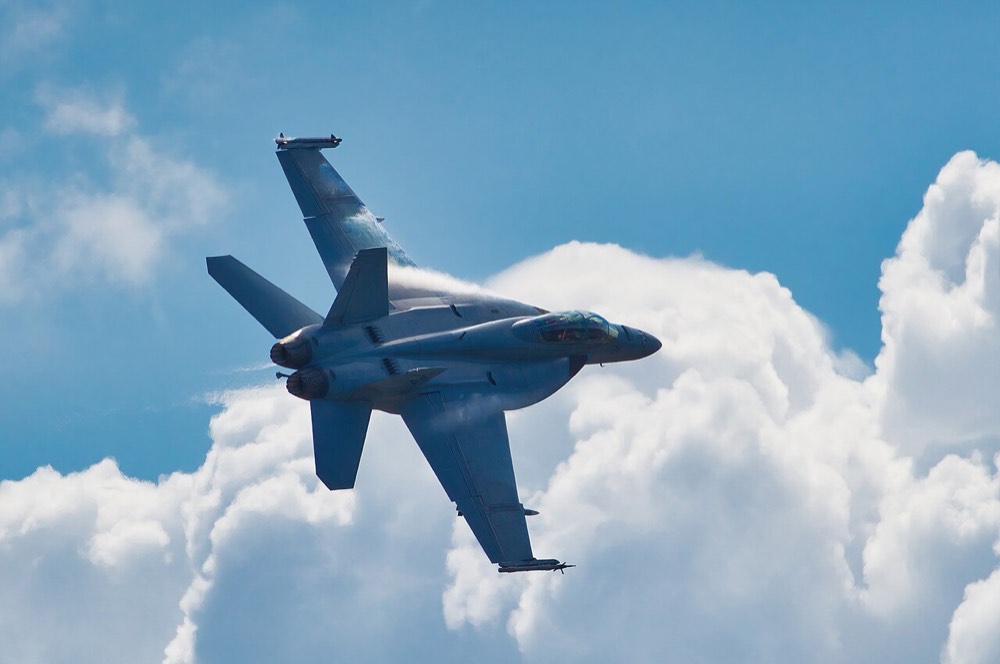
F/A-18 Rhino
U.S. Navy Rhino Demonstration Team · Boeing Super Hornet
Loudest thing today
F/A-18F Super Hornet · Wikimedia Commons
Not a CF-18 with new parts. The Super Hornet is a substantially larger, different aeroplane that kept the name for budgetary reasons. On a damp day like this one it is a vapour machine.
Engines
2 × GE F414
vs legacy Hornet
~25% larger
Top speed
~Mach 1.6
Intakes
Rectangular caret
First flight
1995 · service 1999
Today is a vapour day — here is the physics
The white clouds that form over the wings in a hard turn are not smoke and not the sound barrier. Air accelerating over the leading-edge extensions — the strakes running from the wing root up alongside the cockpit — spins into two tight vortices. Pressure inside a vortex core drops, temperature drops with it, and the water already in the air condenses. In post-rain humidity, expect the Rhino to drag visible vortex ropes off both sides on every pull. This is one of the best weather days of the year for it.
Why “Rhino”?
Carrier decks and radio calls need unambiguous names. With both legacy and Super Hornets aboard, “Hornet” was dangerously vague, so the Super Hornet became the Rhino — reportedly for the longer nose. It stuck hard enough that the demonstration team is named for it.
Ear protection
Two F414s in afterburner, low and close, in cool dense damp air, is the loudest thing on today’s schedule. If there are children with you, this is the act for the ear defenders.
13
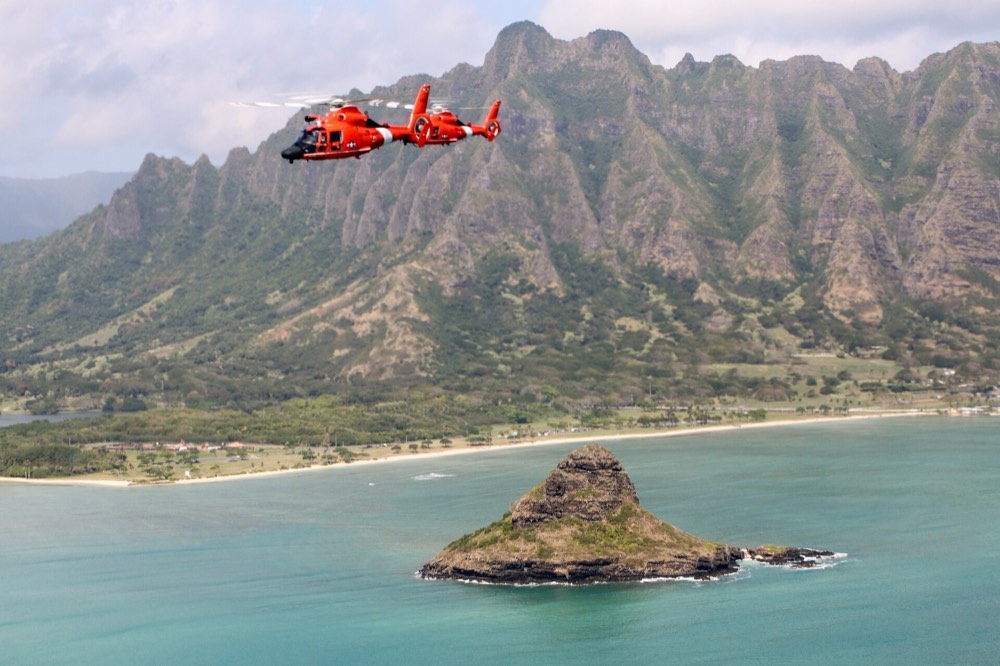
MH-65 Dolphin
United States Coast Guard · Airbus (Aérospatiale) SA.366
Flies when jets can't
USCG MH-65 Dolphin · Wikimedia Commons
The Coast Guard’s short-range recovery helicopter, and the easiest aircraft on the field to identify — because of the tail.
Tail rotor
Fenestron, shrouded fan
Engines
2 × Turbomeca Arriel
Range
~740 km
Crew
4
Fleet
~98, upgraded to MH-65E
Watch for the Fenestron
Instead of an exposed tail rotor, the Dolphin has a shrouded multi-blade fan buried inside the vertical fin. It is quieter, more efficient in the hover, and — the reason the Coast Guard cares — dramatically safer for deck crews working around a running helicopter on a pitching cutter at night. It also gives the aircraft a distinct voice: a higher, smoother whine rather than the classic tail-rotor slap.
The person on the wire
The demo’s real subject is not the helicopter, it is the rescue swimmer. Note that the hoist operator, not the pilot, effectively conns the aircraft during a pickup — the pilot cannot see the person below and flies to the operator’s voice. That relationship is the whole demonstration.
14
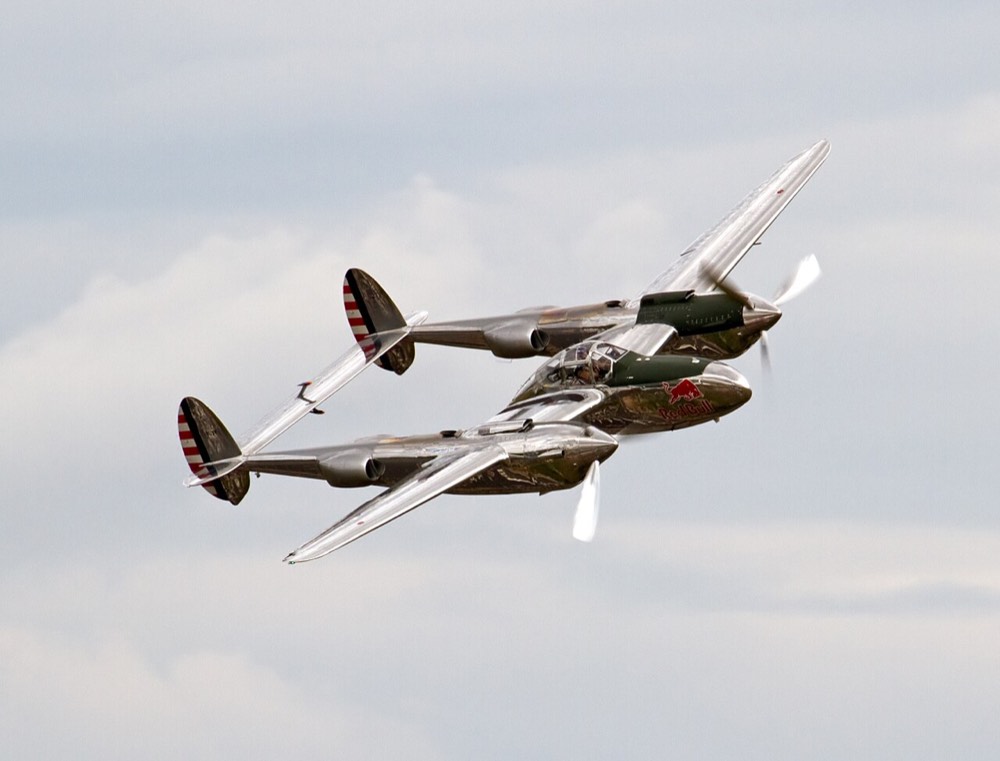
P-38 Lightning
Lockheed · first flight 27 January 1939 · roughly ten airworthy worldwide
Very rare
Lockheed P-38 Lightning · Wikimedia Commons
Take a proper look at this one. Of more than ten thousand built, about ten are still airworthy anywhere in the world — it is far rarer than a Spitfire. It flies solo here, then comes back in the Heritage Flight to close the show.
Engines
2 × Allison V-1710, counter-rotating
Top speed
~670 km/h
Guns
4 × .50 cal + 20 mm, all in the nose
Crew
1
Built
10,037
Airworthy now
~10
Watch for
Counter-rotating propellers. The engines turn opposite ways, cancelling torque and the asymmetric pull that makes single-engine fighters swing. It is why the P-38 was unusually easy to aim.
All guns in the nose. Wing guns must be harmonised to converge at one chosen distance; nose guns fire in a parallel stream at any range. Pilots described it as using a hose rather than throwing a bucket.
The booms. Not styling — they carry the turbochargers and radiators, which is what leaves the nose free to be filled with guns.
Two things it is famous for
The two highest-scoring American aces of the war, Richard Bong (40) and Thomas McGuire (38), both flew P-38s in the Pacific. And in April 1943 P-38s flew a 1,600 km round trip at wave height under radio silence to intercept the aircraft carrying Admiral Isoroku Yamamoto — Operation Vengeance, made possible only by this aircraft’s range.
15
F-22 Raptor
USAF F-22 Raptor Demonstration Team · JB Langley-Eustis, Virginia
Headliner
F-22 Raptor Demo Team, Toronto · Wikimedia Commons
The reason most people bought a ticket. The Raptor does things in front of a crowd that look like a physics error, and the explanation is simple: it is the only aircraft you will see today that can point its engines somewhere other than straight back.
Engines
2 × P&W F119
Thrust vectoring
±20° in pitch
Supercruise
Mach 1.5+ without afterburner
Top speed
~Mach 2.25
Built
187 — line closed 2011
The manoeuvres, and what they prove
The high-alpha pass. Nose absurdly high, mushing along slowly, clearly not stalling. Any other fighter here would depart controlled flight. The nozzles are holding the nose up.
The tail slide. Pitch vertical, let airspeed bleed to zero, slide backwards, recover. Aerodynamic controls do nothing at zero airspeed; vectored thrust does not need airflow.
The J-turn. Watch the flight path against where the nose points. They stop agreeing. That decoupling is the entire idea.
One fact
Only 187 were built and the line was deliberately closed in 2011. The tooling is gone. The USAF cannot buy another F-22 at any price — when people call it irreplaceable they mean it literally.
Today
Under a low ceiling it flies the flat profile: no vertical set-pieces, but more of the low-speed high-alpha work, which is the genuinely unique part anyway. Cool damp air also makes afterburner shock diamonds and vapour far more visible.
16
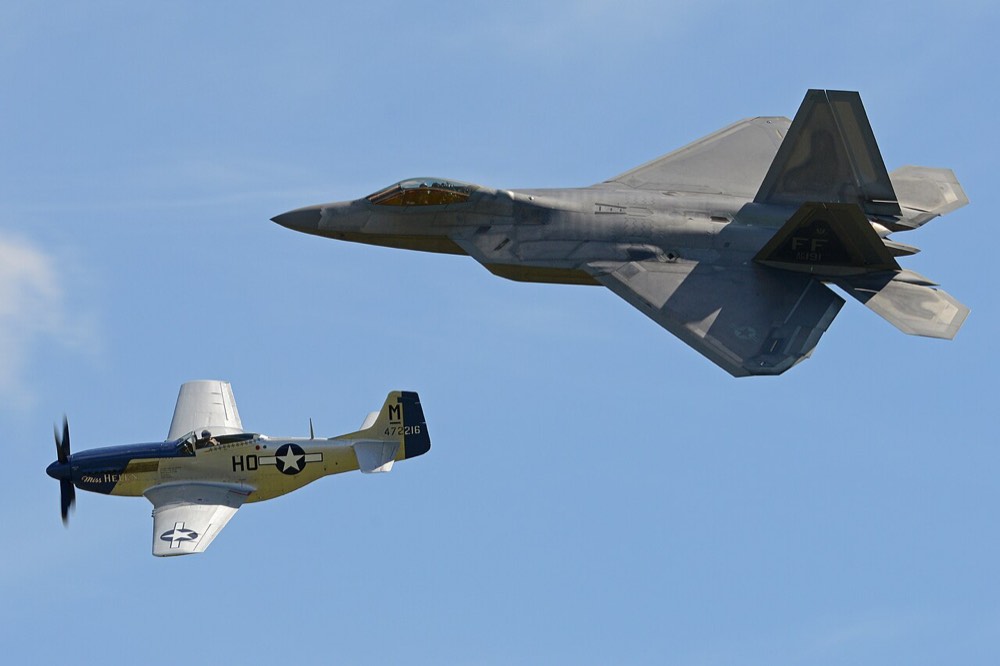
Heritage Flight
USAF F-22 Raptor + P-38 Lightning · programme established 1997
The closer
USAF Heritage Flight · Wikimedia Commons
The last thing you will see, and the best photograph of the day: a stealth fighter and a 1939 twin-boom piston fighter holding formation. Seventy years of air power in one frame. Stay for it.
Programme since
1997
Certification
Annually, each March, Davis-Monthan AFB
Speed gap
P-38 cruises ~320 km/h
F-22 flies
dirty and slow to match
Why this is harder than it looks
The two aircraft have almost no overlapping speed range. The P-38 cruises around 320 km/h; the F-22 does not want to fly there at all. The Raptor holds the formation dirty and slow — high angle of attack, sometimes gear or flaps out, burning fuel at an absurd rate — while the warbird sits at the top of its cruise. It is a formation held together by the fast jet doing all the compromising.
One fact
Heritage Flight pilots are separately certified every year at a dedicated course each March. Being a Raptor demo pilot does not qualify you; mixed-formation work is treated as its own discipline.
Listen, don't just look
Two entirely unrelated engine notes locked to the same flight path: a pair of Allison V-12s and a pair of F119 turbofans. Everyone photographs this and forgets to hear it.
Ground display
Twenty-plus aircraft are parked on the tarmac with crews standing beside them, and it is the most under-used ticket at any airshow. You must watch the flying from your own site, so this is a between-acts activity — or a rain-delay activity, which today is likely.
Ask the crews things. They are standing there specifically to be asked. Good openers: “What breaks most often on this?” · “What is the longest you have been airborne in it?” · “What does it do that people don’t know about?”
Practical
Payment
Credit only. No cash anywhere on site.
Commentary
Broadcast on FM. Use a portable radio — four hours of car stereo will flatten your battery, and you are parked in a field.
Viewing
From your own marked 16×20 ft site only. Tailgate setup encouraged.
Allowed
Chairs, blankets, snacks, non-alcoholic drinks (no glass), ear protection. Tents only if roped or weighted to the vehicle — in today’s gusts, probably leave it packed.
Prohibited
Alcohol outside licensed areas, drones, open flame, weapons, pets (service animals excepted), smoking and vaping.
Thunder
Flying stops, you go to your vehicle. It resumes. Don’t leave early on a rumble.
Getting out
Drive-in shows empty slowly. Either go 15 minutes before the last act, or expect 45–75 minutes of sitting. In this rain, sitting dry is the better trade.
Driving home
If thunderstorms are moving through, the 401 in heavy rain is the riskiest part of the day — not the airshow. Let the worst of it pass before joining the queue.
Camera, in this light
Jets
1/1000 s or faster, continuous AF, burst.
Props & helos
1/160–1/250 s. Slower than feels safe. A frozen prop ruins the shot.
Grey sky
Flat sky, flat photo. Shoot against the treeline or a dark cloud edge, not blank cloud.
Vapour
Damp post-rain air is the best vapour weather of the year. Shoot the Rhino and Raptor through the turn.
Phone
Don’t pinch-zoom — that is a digital crop. Shoot wide, crop later. Lock exposure on the aircraft, not the sky.